Owner or MD
One dashboard across sales, production, stock and cash.

One system. Every department.
A modular Enterprise Resource Planning platform unifying finance, procurement, manufacturing, inventory, sales, and HR on a single data backbone. Built for mid-to-large enterprises.
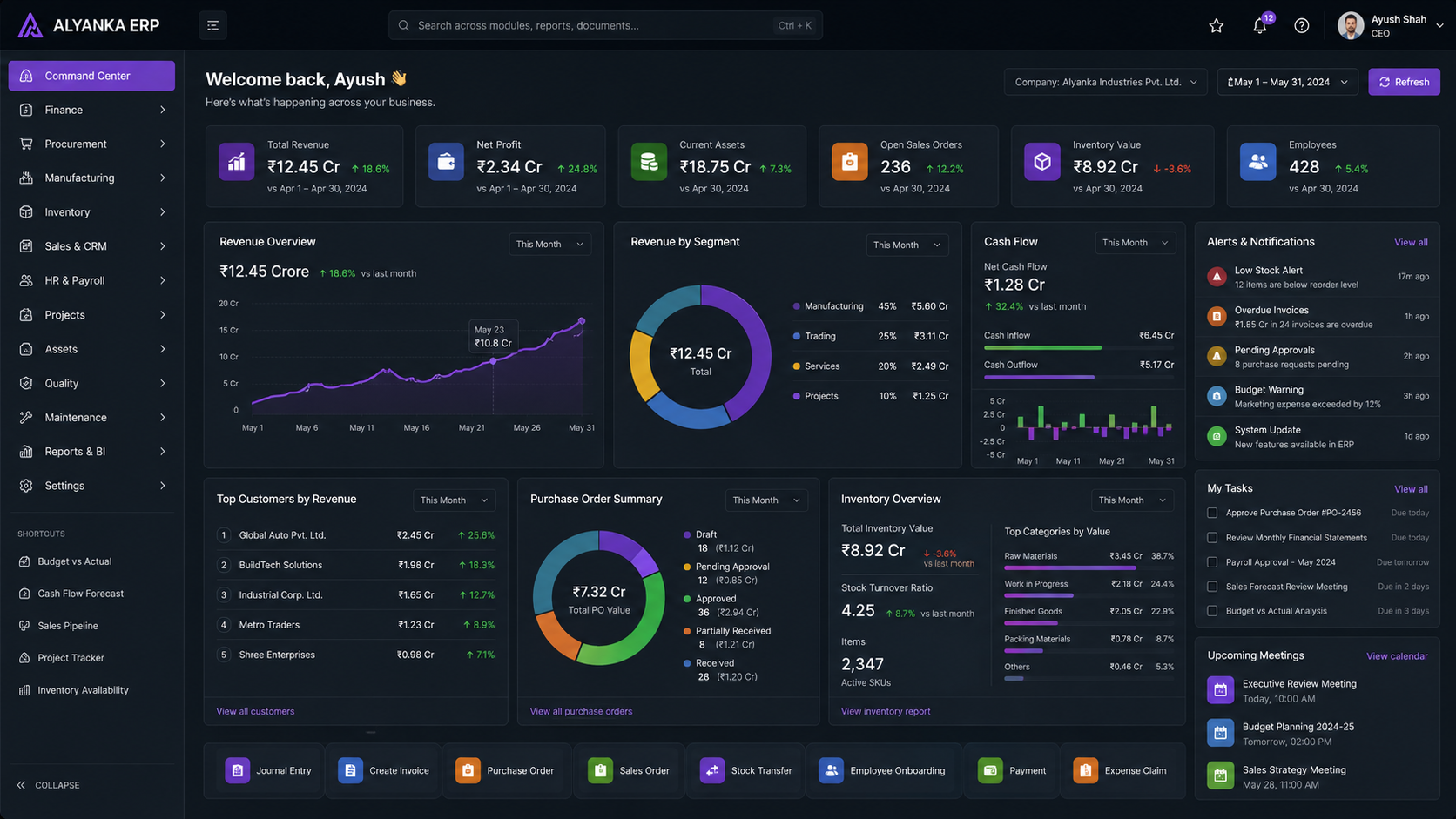
Enterprise ERP eliminates the silos that plague growing businesses. Finance, procurement, manufacturing, inventory, sales, and HR all share a single source of truth, meaning every transaction, every report, and every decision is based on the same real-time data.
Built on Laravel and Vue 3 with a PostgreSQL backbone, Enterprise ERP is engineered for mid-to-large organisations that need modular adoption, multi-company consolidation, and audit-grade traceability across every business function.
Updated 3 October 2026 by Ayush Patel, founder of Alyanka
Six core modules that cover the full enterprise operation, adopt one or deploy all, they share one data backbone.
General ledger, AP/AR, multi-currency, inter-company transactions, fixed assets, and financial statements, all on a single chart of accounts.
Purchase requisitions, RFQ workflows, vendor onboarding, PO management, goods receipt, and three-way matching with auto-invoice posting.
BOM management, work orders, MRP, production scheduling, shop-floor tracking, and capacity planning with real-time WIP visibility.
Multi-warehouse stock, batch and serial tracking, bin management, cycle counts, stock valuation, and real-time movement logs.
Quotation-to-order-to-invoice workflows, customer master data, sales analytics, and seamless integration with the CRM Pro module.
Employee master, attendance, payroll, and expense management, fully integrated with finance for automatic journal postings.
The everyday flow in Enterprise ERP, from the first entry to the final report. Each step hands over to the next without re-typing.
Sales orders are booked once and visible to every department.
Material requirements and production plans are generated from open orders.
Purchase requests and orders go to suppliers with approvals built in.
Production is issued, tracked by stage and recorded on output.
Invoices, dispatch documents and ledgers update automatically.
Each person sees what they need and nothing else. Access is set by role.
One dashboard across sales, production, stock and cash.
Plans, issues and tracks jobs against orders and capacity.
Raises and tracks purchase orders from actual requirements.
Receives invoices and entries without re-typing, synced to Tally.
Every transaction, every report, and every dashboard draws from one real-time database, no more reconciliation nightmares.
Start with one module and add others as you grow, every module shares the same data backbone, so no re-platforming ever.
Every record carries a full audit trail, who, what, when, with immutable change logs for statutory and internal audits.
Manage multiple legal entities, currencies, and charts of accounts with consolidated reporting and inter-company elimination.
Ready-made, filterable and exportable to Excel or PDF. Add your own when you need them.
Configured to the way each kind of business already works.
BOM-driven production planning, raw material procurement, work-order tracking, and cost-of-goods analysis in one system.
Multi-warehouse inventory, sales order fulfilment, vendor management, and real-time margin analysis across product lines.
Multi-entity consolidation, inter-company transactions, and group-level financial reporting for holding companies and conglomerates.
Project accounting, resource costing, and milestone billing integrated with procurement and payroll for accurate project P&L.
No rip-and-replace. Enterprise ERP reads from and writes to the systems your team already trusts.
TallyExcelBiometric devicesWhatsAppGmailBarcode scanners
LaravelVue 3PostgreSQLRedisRabbitMQREST APIDocker
Role-based access, encrypted connections and a full change log. Read how we handle data on the security page.
A typical rollout. The exact plan is agreed after a short look at your current process.
Your flow from enquiry to payment documented department by department.
The department with the most pain goes live first, usually stores or sales.
Purchase, production and accounts added in stages, with training for each.
Cross-department reports switched on once data is flowing reliably.
Fully managed SaaS deployment with automatic updates, monitoring and backups, and zero infrastructure to maintain.
Deploy Enterprise ERP on your own servers behind your firewall. Full data sovereignty, LDAP/AD integration, and complete control over updates.
Rebrand Enterprise ERP with your company's logo, colours, and domain. Perfect for system integrators offering ERP as a managed service.
Yes. Enterprise ERP is modular by design. Start with finance or inventory and add manufacturing, procurement, or HR later, every module shares the same data backbone, so no migration is needed.
Absolutely. Enterprise ERP supports multiple legal entities with separate charts of accounts, inter-company transactions, elimination entries, and consolidated financial statements at group level.
A single-module deployment for a mid-size company goes live in 6–8 weeks. Full multi-module implementations typically take 4–6 months, including data migration, configuration, and training.
Yes. Enterprise ERP offers a REST API, webhooks, and pre-built connectors for Tally, QuickBooks, bank APIs, GST portals, and major e-commerce platforms. Custom integrations are supported via the API layer.
Yes. Enterprise ERP includes granular role-based access control down to field level, with approval workflows, delegation rules, and full audit logging for every action taken in the system.
A 30-minute live demo with the founder, set up around how your team works today. You leave with a clear view of fit, rollout and cost.
Message or call and we will fix a 30-minute slot that suits you, usually within two working days.
Name and phone are required.